CONCLAVE
Multi-Agent LLM Decision System
The problem this had to solve.
Compare role-specialised consensus with simpler mutual-fund ranking baselines without presenting a research interface as financial advice.
CONCLAVE ingests public mutual-fund and economic data from AMFI, MFAPI, yfinance, and RBI sources, then turns it into a feature set covering more than 20 fund metrics.
Four role-specialised LLM agents can run through Gemini or local Ollama/Qwen2.5-7B providers. Their outputs feed deterministic consensus and fallback behavior before evaluation, backtesting, and six-tab Streamlit exploration.
Constraints
- The current 86-fund snapshot contains surviving Indian open-ended equity funds and is subject to survivorship bias.
- Available NAV history begins in 2013, so the persisted multi-vintage study covers a predominantly bullish market regime.
- Live ingestion depends on AMFI, MFAPI, RBI/manual inputs, and yfinance availability.
- LLM calls are optional and non-deterministic; heuristic and mock fallbacks are required for reproducible offline runs.
How the system is put together.
Public data sources
AMFI, MFAPI, yfinance, and RBI data
sourceIngestion
Collect and normalize source material
processFeature engine
Build 20+ fund metrics
processFour specialised agents
Provider-agnostic Gemini or Ollama/Qwen2.5-7B inference
processConsensus
Deterministic decision and fallback behavior
decisionEvaluation
Backtesting and result analysis
processDashboard
Six-tab Streamlit exploration
outputWhat was chosen, and what it cost.
Separate evidence from model judgement
- Choice
- Engineer return, risk, cost, and consistency objectives before asking four role-specialised agents to rank candidates.
- Rationale
- Every agent receives the same bounded fund evidence while its role changes the priority applied to that evidence.
- Cost
- The role prompts are deliberately prescriptive, so the agents are closer to specialised rerankers than unconstrained analysts.
Keep a deterministic decision path
- Choice
- Aggregate proposals with explicit consensus and fallback logic instead of delegating the final result to one free-form response.
- Rationale
- Offline runs remain reproducible when a provider is unavailable and negotiation decisions can be replayed.
- Cost
- Fallback-heavy runs cannot be treated as evidence of LLM reasoning quality.
Evaluate against simple baselines
- Choice
- Backtest consensus alongside mean-of-objectives, five-year CAGR, random, and bottom-five controls.
- Rationale
- A complex agent workflow should be compared with inexpensive ranking rules before claiming an advantage.
How it was checked.
- The repository includes automated tests, backtesting scripts, evaluation baselines, and persisted research reports.
- The multi-vintage analysis covers 36 paired vintage/category cells; its reported consensus-versus-simple-baseline effect is directional but not significant at the two-sided 0.05 level.
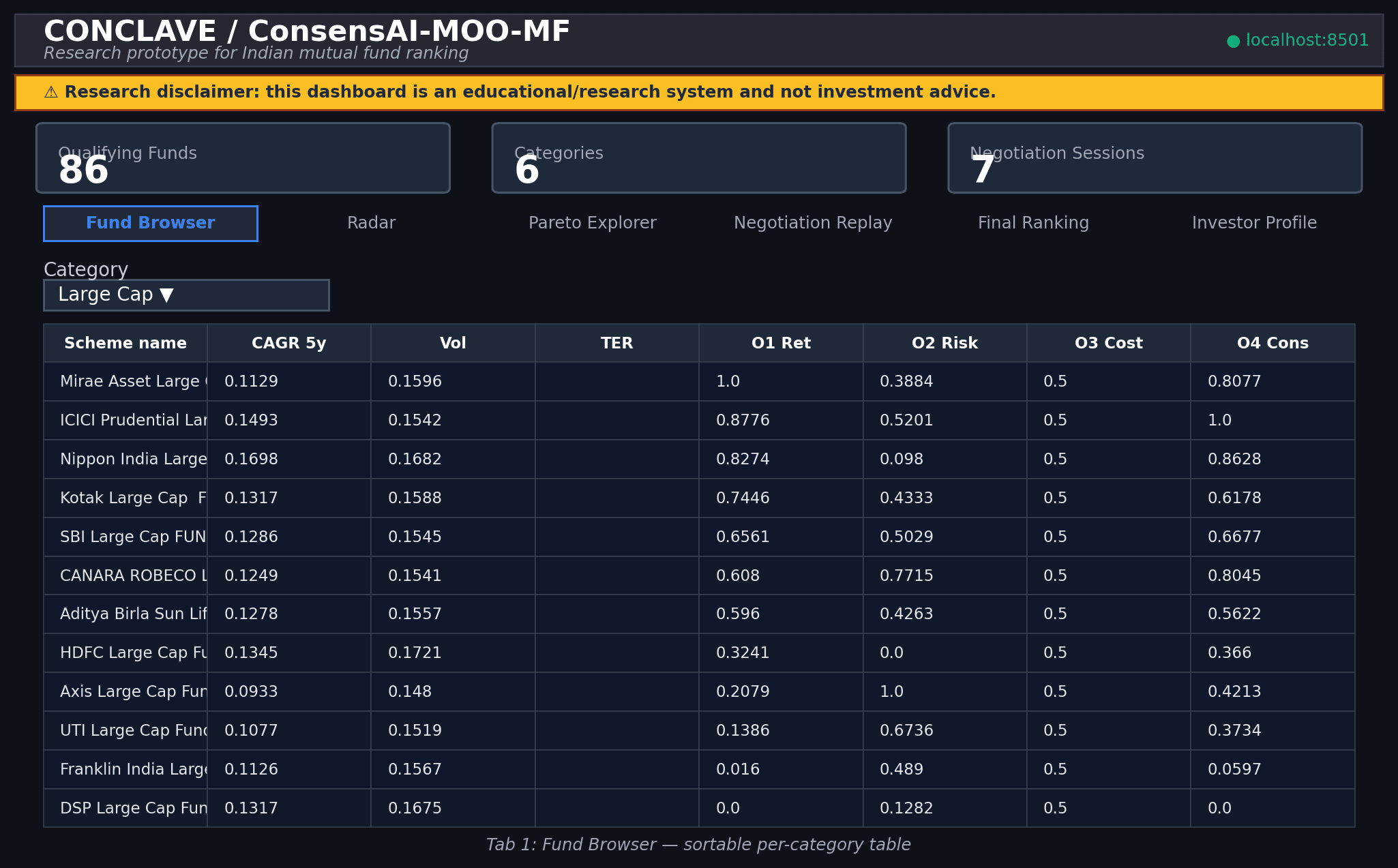
- The Streamlit application exposes six tabs for inspecting funds, sessions, comparisons, and investor-profile reranking.
What was measured.
Each figure states the conditions it was measured under. None of them describe production traffic.
4
role-specialised agents
Independent roles contribute to the ranking decision.
20+
fund metrics
Features assembled from public market and economic sources.
6
dashboard tabs
A Streamlit interface supports interactive exploration.
Where this stops being true.
- The repository explicitly excludes real-money execution, financial advice, hosted deployment, and guaranteed live-data availability.
- Historical TER data is unavailable in the snapshot, category-specific benchmark history is incomplete, and external CRISIL/Value Research validation is not persisted.
- The LLM study uses a single local model and mostly single-round negotiation; trained adapter inference was not evaluated end to end.
- The dashboard does not yet surface the multi-vintage backtest summary.
What it is built with.
Runtime & interface
- Python
- Streamlit
Data & evaluation
- Pandas
- NumPy
- SciPy
Infrastructure & providers
- Ollama
- Qwen2.5-7B
- Gemini